

One of the most common mistakes made by parents seen by police officers, firefighters and other professionals that can cause your child to lose their life happen in your car. Car seats and improper use to this day with all of our safety features and technology are used incorrectly to the detriment of our children’s health. As an example in 2018 Kentucky State Police Traffic Collision Facts report http://kentuckystatepolice.org/wp-content/uploads/2019/10/Crash-Facts-2018-FY2019-FINAL.pdf.

So, here are the top 10 most common questions regarding Child restraints in Kentucky according the Kentucky Department of Safety
1. What is Kentucky’s child safety seat law?
40 inches or less must be properly restrained in a federally approved safety seat. Children younger than seven and between 40 and 50 inches must be properly secured in a booster seat. KRS 189.125 [i]
2. WHAT IS THE FIRST THING I SHOULD DO WHEN INSTALLING A CAR SEAT?
Yes, guys READ THE DIRECTIONS!! It doesn’t take long and I’m 100% sure everyone of you feel like your child’s life is worth the 5-minute read
3. WHEN CAN MY CHILD GO FORWARD-FACING?
A child must be kept rear-facing to a minimum of 20 pounds and one year of age, with best practice being 18-24 months. When using a convertible seat, it is best to keep the child rear facing until the maximum rear-facing weight. Guess where you will find it…according to the manufacturer’s instructions.
Most people find this to be a terrible idea and argue that my child’s legs hit the seat and might break their legs or dislocate their hip, well I was unable to locate any documentation to support that, but I will concede I’m sure it does exist, but a broken leg or dislocated hip heals a neck fracture is typically permanent at those ages and lead to death. Check out this clip for an excellent explanation of front vs. rear.
4. WHICH SLOTS SHOULD I USE FOR THE HARNESS STRAPS?
When rear-facing, the harness straps should be at or below the child’s shoulders, according to the manufacturer’s instructions.
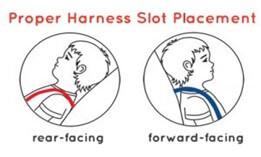
When forward-facing, the harness straps should be at or above the child’s shoulders, according to the manufacture’s instructions.
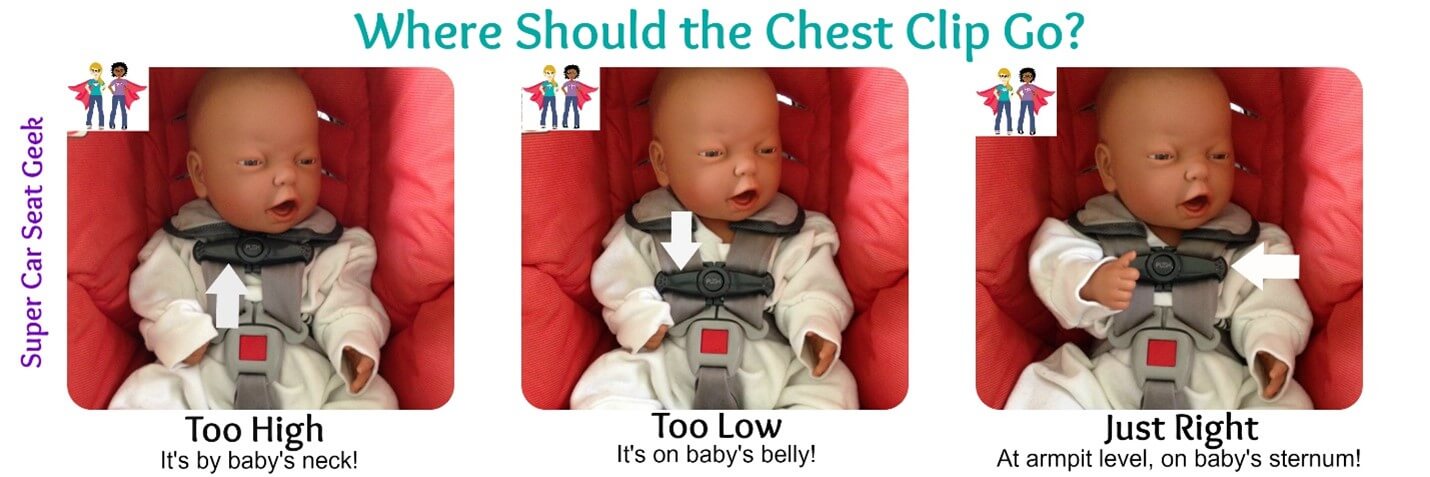
5. WHAT IS THE CLIP LOCATED ON THE HARNESS STRAP?
This is called the retainer clip and should be kept at armpit level. This enables the harness to stay in the proper position.
6. HOW TIGHT SHOULD THE HARNESS STRAPS BE ON THE CHILD?
No more than one finger should fit between the child’s collar bone and the harness strap. The straps should be sung against the child’s shoulders so you cannot pinch any excess webbing.
7. HOW TIGHT SHOULD MY CHILD SEAT BE IN THE VEHICLE?
The child seat should not move more than one inch side-to-side or back-and-forth when pulling at the belt path.
8. HOW DO I KNOW IF MY CAR SEAT NEEDS TO BE REPLACED?
If the seat is older than 6 years or has exceeded the manufacturer’s expiration date, it must be replaced. Also, if your seat has been involved in a crash, it must be replaced. First check with your insurance company before you purchase a new seat. This is why I highly caution anyone buying a car seat from a consignment store or a yard sale.

9. SHOULD MY CHILD BE IN A BOOSTER SEAT?
Safety Belt Safe USA recommends children under 80 or 100 pounds to be in a booster. Since seat belts are made for adults, it best to keep children in a child seat for a longer period of time. Also refer back to the KRS list above.
10. WHEN CAN MY CHILD SIT IN THE FRONT SEAT?
The risk of injury is greater in the front seat for children, with or without an airbag. Research shoes it is best for children 12 and under to ALWAYS ride in the back seat.
So, what are the different types of safety seats?
Infant seat
- Use rear-facing only, from birth until upper weight limit (check seat label).
- A child must remain rear0facing to a minimum of 20 pounds and one year of age, with best practice being 18 to 24 months.
Convertible seat
- May be used both rear-facing and forward-facing
- Use until the upper rear-facing weight limit on the seat (check seat label).
- Use forward-facing for children over one ear of age and 20 pounds, until the upper forward-facing weight limit on the seat (check seat label).
Forward-facing seat with harness
- For children over one year of age and over 20 pounds, up to 40 pounds or more (check seat label).
Combination forward-facing seat with harness/booster
- Use with a harness for children over one year of age, up to 40 pounds or more (check seat label).
- Remove harness at weight limit and use as a booster seat.
Booster seat
- Safety Belt Safe USA recommends using with children over 40 pounds, up to 80 pounds or more (check seat label).
- Must be used with a lap-shoulder belt. Ensure this is properly used!!
 Research shows child safety seats are 71% effective in reducing fatal injury for infants (less than one year old) and 54% effective for toddlers (one to four years old) in passenger cars. In light trucks, the effectiveness is 58% for infants and 59% for toddlers. The use of belt-positioning booster seats lowers the risk of injury to children by nearly 60% compared to the use of seat belts alone.[ii]
One final piece of information, NHTSA recommends that child safety seats and boosters be replaced following a moderate or severe crash in order to ensure a continued high level of crash protection for child passengers. Here is what a minor accident looks like, anything greater than this would meet the criteria to replace.
Minor accident:
- The vehicle was able to be driven away from the crash site;
- The vehicle door nearest the safety seat was undamaged;
- There were no injuries to any of the vehicle occupants;
- The air bags (if present) did not deploy; AND
- There is no visible damage to the safety seat
In case you’re wondering most insurance companies will replace your car seat or booster seat, I would suggest you reach out to them and ask.
Other great resources
- Children’s Hospital of Philadelphia (CHOP): chop.edu
- CPS Safety: cpsafety.com
- National Center for Injury Prevention and Control: cdc.gov/ncipc/factsheets/childpas.htm
- National Highway Traffic Safety Administration(NHTSA): nhtsa.dot.gov
- National Injury Prevention Foundation “ThinkFirst”: thinkfirst.org/kids/
- National Safety Council: nsc.org/raf/sbc.htm
- SAFE KIDS Coalition: usa.safekids.org
- Safety Belt Safe USA: carseat.org
- Kentucky Transportation Cabinet: http://highwaysafety.ky.gov
—–
[i] https://apps.legislature.ky.gov/law/statutes/statute.aspx?id=45204
[ii] https://transportation.ky.gov/HighwaySafety/Documents/childseat_info.pdf