

I was inspired to write this blog after reading the article about the Sarasota County Sheriff Office’s list of 15 apps parents should have on their radar. That same department has quickly expanded the list to include 6 more apps, bringing the total to 21 apps. The list is below with a description of each app. There is a terrifying epidemic in this country of sex trafficking happening in nearly every state, city, town and even homes. Of course, our largest concern is for our children, our daughters in particular. The reality is age, sex, race, hair and eye color really does not really matter! Let’s face the facts! As parents, unless you are very, very tech savvy, alone we just cannot keep up with our children and the every changing app worlds. This list is probably becoming obsolete by the time I finish this sentence. While you may be able to trust your children with technology, can you trust that the other people on the apps are who they say they are? Misleading children to meet, saying they’re another teenage girl or boy, only to realize too late…
Just pulling up headlines from the last few days, here is what I have found:
South Carolina DJ Accused of Sex-Trafficking Nearly 700 Black Girls
Suspects in multi-state sex trafficking ring plead guilty N.M.
15-year-old sex trafficking victim commits suicide Tx.
Milwaukee woman accused of sex trafficking girls she was supposed to be protecting
According to the FBI, in 2018, there were 424,066 NCIC (National Crime Information Center) entries for missing children. In 2017, the total number of missing children entries into NCIC was 464,324. This number represents reports of missing children. That means if a child runs away multiple times in a year, each instance would be entered into NCIC separately and counted in the yearly total. Likewise, if an entry is withdrawn and amended or updated, that would also be reflected in the total. This is based off the children that are reported missing. Sadly, there are many thousands more children who go unreported. Further data from The International Labour Organization…
- The International Labour Organization estimates that there are 40.3 million victims of human trafficking globally.
- 81% of them are trapped in forced labor.
- 25% of them are children.
- 75% are women and girls.
- The International Labor Organization estimates that forced labor and human trafficking is a $150 billion industry worldwide.
- The U.S. Department of Labor has identified 148 goods from 75 countries made by forced and child labor.
- In 2017, an estimated 1 out of 7 endangered runaways reported to the National Center for Missing and Exploited Children were likely child sex trafficking victims.
- Of those, 88% were in the care of social services or foster care when they ran.
- There is no official estimate of the total number of human trafficking victims in the U.S. Polaris estimates that the total number of victims nationally reaches into the hundreds of thousands when estimates of both adults and minors and sex trafficking and labor trafficking are aggregated.
So, what can you do to help protect your children?
- Talk to your children about sex trafficking. Show them news articles and educated them on the signs to look for in others (see below)
- The phone they use is not their private property and yes YOU can look at it any time you want. KNOW what apps are on their phone, who is in their contact list, look at their pictures!
- Look at their social media pages (all of them).
- Younger children do NOT have to have a smart phone. Pre-paid flip phones work well and your teenage will survive without a smart phone (mine does).
- Do NOT use your cell phone when walking (being distracted puts EVEYONE at risk)
- Do not sit read/text/ set up music when sitting in your car in a parking lot
- ALWAYS lock your doors as soon as you get in your car
- When leaving work after dark, ask for a security escort or walk out with others
- If someone is following you, run far from them in a zigzag direction into the nearest place possible where more people are.
- FIGHT LIKE HELL! (Learn self-defense! I recommend Krav Maga with Reality Krav Maga)
Some signs of human trafficking…
A victim of labor or sex trafficking:
- May show signs of physical or mental abuse
- May not have control over their own money, ID or personal possessions
- May not be able to speak on their own behalf or unable to leave on their own
- May appear to be fearful or submissive
- May not know what city or state they are in, or where they are living
- May work excessively long hours
- Can be found in restaurants, farming, massage parlors and soliciting at hotels, parking lots or house to house
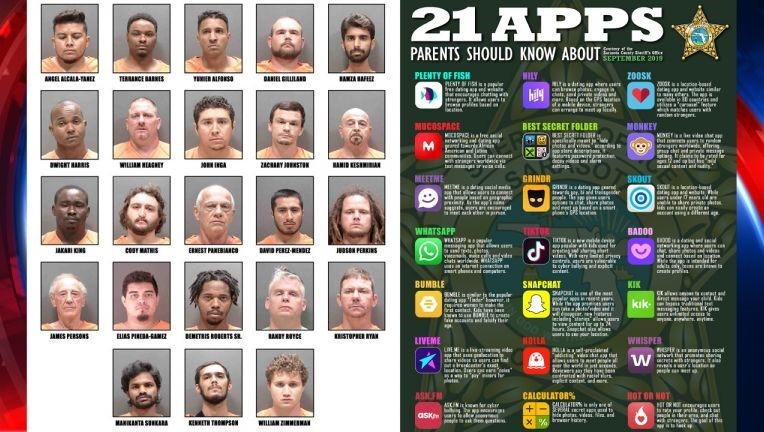
Photo Credit to Sarasota Sheriff’s Department
Plenty of Fish: A popular free dating app and website that encourages chatting with strangers. It allows users to browse profiles based on location.
HILY: A dating app where users can browse photos, engage in chats, send private videos and more. Based on the GPS location of a mobile device, strangers can arrange to meet up locally.
Zoosk: A location-based dating app and website similar to many others. The app is available in 80 countries and utilized a ‘carousel’ feature which matches users with random strangers.
Mocospace: A free social networking and dating app. Users can connect with strangers worldwide via text messages or voice calls.
Best Secret Folder: Specifically meant to hide photos and videos. According to app store descriptions, it features password protection, decoy videos and alarm settings.
Monkey: A live video chat app that connects users to random strangers worldwide, offering group chat and private message options. It claims to be rated for ages 12 and up but has “mild sexual content and nudity.”
MeetMe: A dating social media app that connects people based on location. Users are encouraged to meet in person.
WhatsApp: A messaging app that allows texts, video calls, photo sharing and voicemails with users worldwide.
Bumble: Similar to Tinder, but requires women to make the first contact. Law enforcement says children can create fake accounts and falsify their age.
Live.Me: A live-streaming app that uses geolocation to share videos. The sheriff’s office said users can earn “coins” to “pay” minors for photos.
Ask.FM: The sheriff’s office said this app lets users ask anonymous questions and is known for cyberbullying.
Grindr: A dating app geared toward the LGBTQ community based on user location.
TikTok: A new app popular with children lets users create and share short videos. Law enforcement said the app has “very limited privacy controls” and users can be exposed to cyberbullying and explicit content.
Snapchat: One of the most popular social media apps in the world, Snapchat lets users take and share photos and videos. The app also lets people see your location.
Holla: This self-proclaimed “addicting” video chat app lets users meet people in seconds. Law enforcement said users have seen racial slurs and explicit content.
Calculator+: Police say this is one of several apps that are used to hide photos, videos, files and browser history.
Skout: A location-based dating app that is supposed to prohibit people under 17 from sharing private photos. However, police say children can easily create an account with a different age.
Badoo: A dating and social media app where users can chat and share photos and videos based on location. Police say the app is supposed to be for adults only, but they’ve seen teens create accounts.
Kik: Police say children can bypass traditional text messaging features using this app. Kik “gives users unlimited access to anyone, anywhere, anytime,” the sheriff’s office said. The Kik app is actually going away, although there is no clear date for when it will shut down.
Whisper: An anonymous social network that lets users share secrets with strangers. Police say it also shows users’ location so people can meet up.
Hot or Not: The app lets users rate profiles, check out people in their area and chat with strangers. Police say the goal of the app is to hook up.