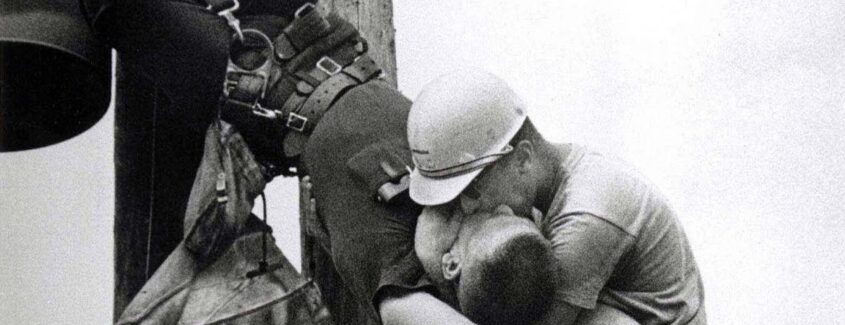
I recently had the pleasure of training a large group of linemen, a greatly misunderstood and underappreciated group of men and women. I was reminded of an image from my childhood I had seen on an old magazine. “The Kiss of Life”, as he been called was a wonderful teaching tool for my class. I would like to recognize and thank M&M Electric Contractors for seeing the importance to CPR and First Aid training!
The Kiss of Life: A Snapshot of Courage and Why Hands-On CPR Training Is a Must

In the annals of photography, few images capture the raw power of human action like The Kiss of Life. Taken on July 17, 1967, by Rocco Morabito, this Pulitzer Prize-winning photograph freezes a moment of life-or-death drama: a utility worker, J.D. Thompson, administering mouth-to-mouth resuscitation to his colleague Randall Champion, who dangled lifelessly from a utility pole after an electrical shock. The image is more than a stunning visual—it’s a testament to quick thinking, skill, and the life-saving potential of CPR. But beyond its historical weight, The Kiss of Life underscores a timeless truth: hands-on CPR training isn’t just good—it’s required. Let’s dive into the story behind the photo and explore why practical instruction is non-negotiable for saving lives.
The Day That Shaped an Iconic Image
It was a sweltering summer day in Jacksonville, Florida, when Morabito, a photographer for the Jacksonville Journal, stumbled upon a scene that would define his career. Randall Champion, a 26-year-old lineman, was performing routine maintenance on a high-voltage line when his shoulder brushed a live wire. The 4,160-volt shock stopped his heart instantly, leaving him unconscious and strapped to the pole, 40 feet above ground. His safety harness held him in place, but time was slipping away—without oxygen, brain damage sets in within minutes.
Enter J.D. Thompson, Champion’s fellow lineman and friend. Working nearby, Thompson heard the zap and Champion’s gasp, then sprang into action. Scaling the pole with the agility of a seasoned worker, he reached Champion, whose lips had turned blue and whose pulse had vanished. With no time to wait for help, Thompson tilted Champion’s head back, pinched his nose, and began mouth-to-mouth resuscitation—right there, midair, on a swaying utility pole. After several breaths, Champion’s chest heaved; his heart flickered back to life. Thompson then slung him over his shoulder and climbed down, where paramedics took over.
Morabito, driving by on assignment, saw the rescue unfold. He grabbed his camera, snapped the shot just as Thompson breathed life into Champion, and titled it The Kiss of Life. The photo ran on front pages worldwide, earning Morabito the 1968 Pulitzer Prize for Spot News Photography. Champion survived, living another 35 years until 2002, thanks to Thompson’s swift intervention.
The Power of the Photograph
The Kiss of Life isn’t just a moment in time—it’s a symbol. It captures the fragility of life and the extraordinary capacity of ordinary people to intervene. In 1967, CPR was still a relatively new technique, formalized just a decade earlier by Dr. Peter Safar and Dr. James Elam, who pioneered mouth-to-mouth resuscitation. Thompson’s training, likely basic by today’s standards, was enough to make the difference. The image became a rallying cry for first aid education, showing that with the right skills, anyone could be a lifesaver.
Visually, it’s gripping: Thompson’s determined face, Champion’s limp form, the stark utility pole against a clear sky. It’s a study in contrasts—danger and hope, stillness and action. Beyond its aesthetic, it humanizes CPR, turning an abstract medical procedure into a visceral act of compassion. For millions who saw it, The Kiss of Life wasn’t just news—it was inspiration.
Why Hands-On CPR Instruction Is Essential
The story behind The Kiss of Life highlights CPR’s potential, but it also begs a question: could you do what Thompson did? The answer hinges on training—and not just any training, but hands-on practice. Here’s why it’s not only good but required:
- Mastering Technique Under Pressure
CPR isn’t intuitive. For adults, it demands 100-120 chest compressions per minute, about 2 inches deep, with full chest recoil between pumps. Mouth-to-mouth, as Thompson performed, requires precise head positioning and breath control. In a crisis—say, on a pole or in a crowded room—adrenaline can throw off your rhythm. Hands-on training with a mannequin builds muscle memory, so when panic hits, your body knows what to do. Reading a manual or watching a video can’t replicate that. - Adapting to Real Scenarios
Thompson didn’t perform CPR on a flat surface—he adapted to a vertical, unstable perch. Hands-on classes teach you to adjust: two hands for adults, one for kids, two fingers for infants. You learn to navigate obstacles—clothing, uneven ground, a victim’s size—things a screen can’t simulate. Instructors can throw curveballs, mimicking real emergencies, so you’re not caught off guard. - Building Confidence to Act
Studies show bystanders hesitate without training, fearing they’ll “do it wrong.” Thompson acted because he knew his skills. Hands-on practice—pressing on a dummy, feeling the resistance, hearing the click of a correct compression—instills certainty. You’re less likely to freeze if you’ve done it before. Confidence isn’t theoretical; it’s forged through repetition. - Learning the Full Scope
CPR isn’t just compressions. Hands-on courses often include AED (automated external defibrillator) training, critical for restarting a heart in cases like Champion’s. You practice placing pads, following prompts, and staying calm as the machine charges. Thompson didn’t have an AED in 1967, but today, it’s standard—and you can’t learn it from a book. - Immediate Feedback
In a classroom, instructors correct your form—too shallow, too fast, wrong hand position. That real-time critique is gold. Online tutorials can’t tell if you’re off-beat or breaking ribs unnecessarily. Precision saves lives; hands-on guidance ensures it.
Why “Good” Isn’t Enough—It’s a Requirement
Sure, basic CPR knowledge is “good”—it’s better than nothing. But in a world where cardiac arrest kills over 350,000 people annually outside hospitals, good doesn’t cut it. Survival odds drop 10% per minute without CPR; bystanders who act immediately can triple those odds. Thompson didn’t guess—he knew. Hands-on training bridges the gap from “I might help” to “I will help.”
It’s also a numbers game. Only 46% of out-of-hospital cardiac arrest victims get bystander CPR. More trained hands mean more lives saved—whether it’s a lineman on a pole, a parent by a pool, or a stranger on a subway. Requiring hands-on instruction isn’t elitist; it’s practical. Organizations like the American Heart Association offer courses in hours, not weeks, often for free or low cost. Schools, workplaces, and communities can mandate it, just as they do fire drills.
Final Thoughts: A Legacy Worth Living
The Kiss of Life isn’t just a relic of 1967—it’s a call to action in 2025. J.D. Thompson’s split-second courage, honed by training, gave Randall Champion decades more with his family. Imagine the ripple effect if we all had that skill. Cardiac arrest doesn’t wait for paramedics, and neither should we.
Hands-on CPR training isn’t optional—it’s a requirement for a safer world. It turns a famous photo into a personal mission. Sign up for a class today. Practice until your hands ache and your rhythm’s steady. Because one day, you might be someone’s kiss of life—and that’s a legacy worth chasing.